
Cat6A Cabling Installation in Toronto, Mississauga and the GTA
We pull, terminate, certify and document Cat6A cabling for offices, warehouses, schools, clinics, game studios and new construction across the Greater Toronto Area. Every drop is Fluke tested to TIA-568.2-D, every job comes with a test report, and complete systems can be registered for a 25 year manufacturer warranty.
Cat6A is not one service. Depending on the building it is a fresh pull through open ceiling, a rip and replace of a failing Cat5e system, a rack build, a rough-in on a construction schedule, or a rescue job on someone else’s install that will not certify. Below is what we actually do, where we do it, and what is included in the price.
Send a floor plan and a drop count. We will give you a realistic range on the phone and a firm price after the site walk. Site walks are free.
1-647-846-1925
Local 647-846-1925 · Mon to Sat, 8am to 8pm
Related cabling services
Our Cat6A Services
These are the pieces we get called for. Most projects are a combination of two or three of them.
New Cat6A installations
Complete horizontal builds from telecom room to outlet. Pathway, J-hooks or cable tray, cable, jacks, faceplates, patch panels, dressing, labelling and certification. Ten drops or a full floor, same standard either way.
Wireless access point cabling
Cat6A drops to ceiling and wall mounted APs for Wi-Fi 6E and Wi-Fi 7. Multigig uplinks, PoE++ capable runs, mounting hardware, and coordination with whoever is running your wireless survey. This is the single most common reason a GTA office moves from Cat6 to Cat6A.
Cat5e and Cat6 upgrades to Cat6A
Replacing cabling that is capping your switch refresh. We work around live operations, cut over in stages so staff stay online, and remove abandoned cable so your ceiling is not carrying three generations of wiring.
Telecom room and rack build-outs
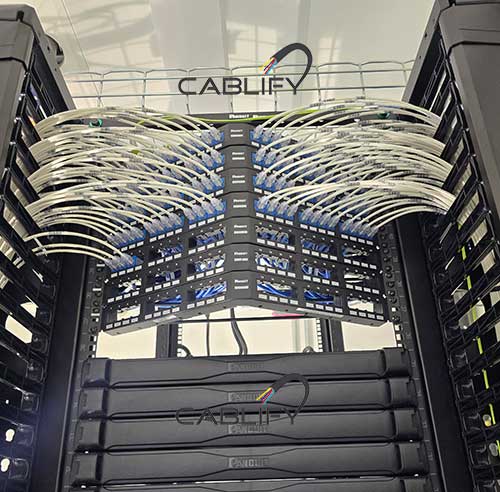
MDF and IDF construction. Racks and cabinets, patch panels, vertical and horizontal management, power distribution, plywood backboards, grounding and bonding busbars, and clean cross connects that the next technician can actually read.
PoE camera and access control cabling
Cat6A for IP cameras, door controllers, readers, intercoms and PoE lighting. High wattage 802.3bt runs bundled and derated properly, so the cable is not cooking above your ceiling two years from now.
New construction and tenant fit-outs
Rough-in during framing, coordination with the electrical and mechanical trades, sleeve and conduit placement before drywall, then trim out and certification ahead of occupancy. We work to consultant drawings and hand back as-builts.
Certification, testing and troubleshooting
Fluke DSX certification to permanent link or channel limits, with a report per drop. We also get called in to diagnose installs that fail, trace unlabelled runs, and re-terminate work that was never properly tested in the first place.
Moves, adds and changes
Ongoing MAC work for offices that reconfigure regularly. Adding drops for a new desk pod, relocating runs after a demising wall goes in, re-patching after a floor rearrangement, cleaning up what the last contractor left.
Cable removal and remediation
Abandoned cable is a fire code issue and it fills the pathways you need for Cat6A. We remove dead runs as part of the upgrade instead of leaving them for whoever comes next.
Fiber backbone to tie it together
Cat6A stops at 100 metres. Where a building needs more reach we run fiber between closets and floors, then Cat6A horizontally from each closet out to the devices. Most buildings need both.
Not a process diagram. This is the line item list, so you can hold a competing quote next to it and see what has been left out of theirs.
Materials
- Cat6A cable, FT4 or FT6 to suit the building
- Cat6A jacks, faceplates and surface boxes
- Cat6A patch panels, 24 or 48 port
- Cat6A patch cords at both ends
- J-hooks, cable tray, conduit and support hardware
- Firestop assemblies at rated penetrations
- Belden, Panduit or Corning components
Labour
- Site walk and pathway assessment before pricing
- Pull, support and dress to standard
- Termination at panel and outlet
- Rack, panel and cable management installation
- Firestopping and pathway penetrations
- Removal of abandoned cable where in scope
- Cleanup and ceiling tile reinstatement
Handover
- Fluke DSX certification on every drop
- Test report per run, PDF and native format
- Labelling to a consistent scheme at both ends
- As-built drawing or drop schedule
- Patch panel port map
- Manufacturer warranty registration where applicable
- A named contact for callbacks
Where We Install Cat6A
A 30 drop office and a 400,000 square foot distribution centre are not the same job scaled up. Here is how we approach the sites we work in most.
Offices and multi-tenant floors
The most common Cat6A work we do in downtown Toronto and across the 905. Usually a fit-out on a leased floor, sometimes an upgrade driven by a switch refresh or a new access point deployment.
- Desk drops, meeting room AV and floor box feeds
- Ceiling APs, digital signage and door hardware on the same infrastructure
- Plenum FT6 where the ceiling void is a return air space, confirmed on the walk rather than assumed
- Landlord and property manager coordination for freight elevators, hoarding and after hours access
- Staged cutovers so staff stay online through the change

Warehouses, distribution and logistics
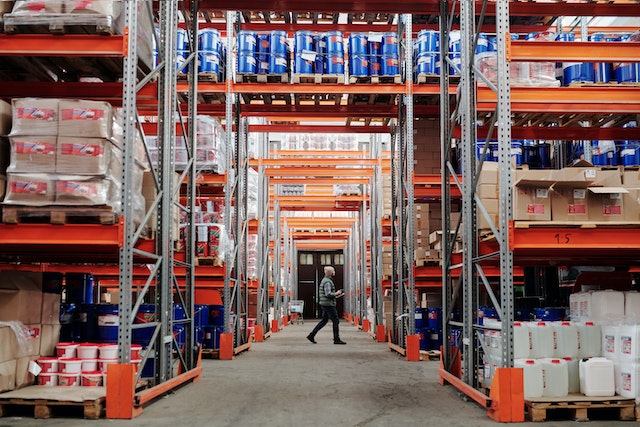
Long spans, high ceilings, scan guns that cannot drop signal, and cameras everywhere. This is where Cat6A earns its length advantage, because Cat6 runs out of 10G distance well before a building like this runs out of floor.
- High bay AP drops at 25 to 40 feet, on lifts, worked around active picking
- Cable tray and conduit fixed to structure where dust and vibration rule out J-hooks
- Camera, gate and dock hardware fed from the same structured system
- Multiple IDFs so no run exceeds 90 metres across a large footprint
- Cold storage, dusty and washdown areas handled with the right cable and enclosure ratings
Game studios, esports and production
Toronto has a serious game development and post-production cluster, and it is a workload that punishes weak cabling. Build machines pushing multi-gigabyte assets to a NAS, QA labs full of test hardware, playtest rooms and capture rigs where a dropped frame is a real problem.
- 10G to the desk for artists, build machines and editing workstations
- Dense QA and test lab drops, labelled per bench so hardware swaps do not turn into cable archaeology
- LAN, playtest and tournament floor cabling with clean protected pathway for temporary runs
- Capture, streaming and control room feeds where latency and jitter matter more than raw throughput
- Wired everywhere it counts, because competitive play and live capture do not belong on Wi-Fi
New construction and base building
On a new build the cable is a rounding error against the cost of opening a finished ceiling later. We work from consultant drawings, hit the trade schedule, and hand over documentation the building will still be using in fifteen years.
- Rough-in at framing, sleeves and firestop assemblies placed before drywall closes
- Coordination with electrical, mechanical and the general contractor on pathway conflicts
- Riser and backbone design, telecom room sizing and location input while it can still be changed
- Trim out, termination, certification and as-built handover ahead of occupancy
- Spec compliance where a consultant has written Cat6A and named a manufacturer
Schools, campuses, clinics and healthcare
Two sectors where Cat6A is usually written into the spec before anyone asks whether it is needed, and for good reason. High device density, long life expectancy, and consultants who want documentation.
- Classroom AP density, one per room or better, plus display and door hardware drops
- Summer and off-hours schedules built around the academic calendar
- Nurse call, patient monitoring and imaging area cabling, frequently shielded
- Infection control and containment protocols on occupied clinical floors
- Full test documentation packages for consultants and facilities departments
Manufacturing, industrial and server rooms
Electrically noisy environments and dense termination work. This is where shielded Cat6A gets specified, and where bonding it correctly separates a working install from an expensive antenna.
- Shielded F/UTP runs near motors, VFDs, welders and heavy ballast loads
- Conduit and armoured pathway on production floors
- Copper 10G to top of rack, structured patching and cross connects
- Properly bonded shielded panels and a grounded telecom busbar, not an afterthought
- See our server room cabling and cable management services
Free site walk anywhere in the GTA. We will confirm your pathway, your plenum rating and whether you actually need Cat6A or whether Cat6 will do the work for less.
Cat6A Against Cat6 and Cat5e
The difference is not speed. Cat6 carries 10 Gigabit too. The difference is how far it carries it, and how much margin is left when the cable is bundled and running PoE.
Cat6 is specified to 250 MHz. It will run 10GBASE-T, but only over a shortened channel, and how short depends on the environment around it. TIA guidance puts that between roughly 37 and 55 metres, with the low end applying where cables are tightly bundled. The limiting factor is alien crosstalk, which is interference between one cable and its neighbours in the same bundle.
Cat6A is specified to 500 MHz and is engineered specifically to control alien crosstalk. Larger conductors, tighter twist rates, and either an internal separator or a foil screen inside the jacket. That is why it holds 10GBASE-T over the full 100 metre channel.
| Cat5e | Cat6 | Cat6A | |
|---|---|---|---|
| Bandwidth | 100 MHz | 250 MHz | 500 MHz |
| 1 Gigabit distance | 100 m | 100 m | 100 m |
| 10 Gigabit distance | Not supported | 37 to 55 m | 100 m |
| Typical conductor | 24 AWG | 23 AWG | 23 AWG |
| Outside diameter | 5.0 to 5.5 mm | 5.5 to 6.2 mm | 7.0 to 9.0 mm |
| Alien crosstalk control | None | Not specified | Specified and tested |
| Suits 802.3bt PoE | Marginal | Acceptable | Preferred |
The 100 metre figure is a full channel. In practice that is a 90 metre permanent link from patch panel to outlet, plus up to 10 metres of patch cord across both ends. Cat6A uses the same RJ45 connector as everything else, so it is fully backward compatible with the Cat6 and Cat5e gear you already own.
One thing worth stating plainly. Cat6A cable terminated into Cat6 jacks does not give you a Cat6A channel. A channel performs to its weakest component. If a quote lists Cat6A cable but does not list Cat6A jacks, panels and cords, it is not a Cat6A install and it will not certify as one.
Shielded or unshielded Cat6A
Both are legitimate. The question is what surrounds the cable.
U/UTP, unshielded, is the default for most commercial offices. It costs less, terminates faster, and modern unshielded Cat6A already controls alien crosstalk through its internal geometry.
F/UTP, foil screened, earns its cost when:
- Cable shares pathway with power, or runs near motors, VFDs or welders
- The site is a production floor, imaging area or broadcast space
- Dense bundles carry high wattage PoE and heat is a concern
- Runs sit close to the 100 metre limit and you want margin
The catch is bonding. A shield that is not bonded correctly is worse than no shield, because it starts behaving like an antenna. Shielded cable needs shielded jacks, shielded panels, shielded cords and a properly bonded busbar in the closet. If a quote lists shielded cable but unshielded hardware, that quote is wrong.
FT4 or FT6, the Canadian question
American spec sheets talk about CMR and CMP. Those markings are not what an Ontario inspector is looking for. CSA fire ratings apply here, and the two that matter are FT4 and FT6.
FT4 is the general commercial rating covering most in-building cable, including vertical riser runs.
FT6 is the plenum rating. If cable passes through a space that returns air to the HVAC system, and in most Toronto office towers that means the open void above the ceiling tiles, FT6 is required. It costs materially more per foot.
This is the single most common reason two quotes for the same floor look wildly different. One contractor priced FT4 and the other priced FT6.
We confirm the return air design on the site walk instead of guessing. A plenum return building and a ducted return building are two different jobs on an identical floor plan.
Ten years ago Cat6A was a data centre and hospital cable. Now it goes into ordinary offices, and Power over Ethernet is why.
802.3bt raised the ceiling to 60 W on Type 3 and 90 W on Type 4 at the switch port. That current travels through the same conductors carrying data, and current makes heat. Bundle forty of those cables together above a ceiling tile and the ones in the middle run hottest, because they have nowhere to shed it.
Heat causes two problems. Insertion loss rises with temperature, which shortens the usable length of every run in that bundle. And a hot bundle can push cable past its rated operating temperature, which becomes a code question rather than a performance one.
Cat6A helps on both counts. Its 23 AWG conductors carry lower DC resistance than 24 AWG, so less energy turns into heat to begin with. Shielded Cat6A does better still, because the foil pulls heat out of the core. The fixes are not exotic either. Keep bundle sizes sensible, spread cable across more pathways instead of fewer, and derate length where the design puts high wattage on long runs.
Why Cat6A installs fail certification
We get called in to fix other people’s Cat6A more often than you would think. It is almost always one of these six things, and every one of them is avoidable.
Pathways sized for Cat6. At the 40 percent conduit fill limit, a 1 inch EMT that carried seven or eight Cat6 cables takes about four Cat6A. Reusing conduit without recalculating fill is how a pull stalls halfway.
Bend radius. Four times the cable diameter for unshielded, more for shielded. Tight bends deform the internal geometry and the tester finds it as return loss.
Pull tension. 110 newtons, roughly 25 pounds, on a four pair cable. Stretching the twist ratio is permanent damage that nothing visible will reveal.
Untwisting at termination. Cat6A jacks allow less untwist than Cat6 does. Half an inch of casual untwisting kills NEXT margin at 500 MHz on a pair that would have passed comfortably at 250.
Cheap patch cords. Channel testing includes the cords. Poor cords fail otherwise clean installs.
Overtightened bundles. Zip ties cinched tight deform the jacket and raise alien crosstalk across the whole bundle. Velcro, loose, at sensible intervals.
Testing, certification and warranty
Every Cat6A run we install is certified, and you get the results in writing.
We test with a Fluke DSX series certifier to TIA-568.2-D permanent link or channel limits. Cat6A at 500 MHz requires a Level IIIe tester or better. A wire map check with a continuity tester is not certification, it does not prove the run will carry 10G, and it does not qualify for a manufacturer warranty.
You receive a labelled test report for every drop, an as-built record showing where each drop lands, and, where the system is built end to end from a single manufacturer’s components, the paperwork for a 25 year manufacturer warranty. We install Belden, Panduit and Corning systems.
If you have an existing installation of unknown quality, we will test what is there and tell you which drops pass and which do not, before anyone recommends replacing anything.
What Drives the Cost of a Cat6A Installation
We do not publish a price per drop, because the same drop can differ by a factor of three between two buildings on the same street. These are the things that actually move the number.
- Ceiling type. Open ceiling with clear pathway is quick. T-bar with a congested plenum is slower. Hard lid drywall means access cutting and patching, and it is the most expensive of the three.
- Plenum rating. FT6 costs materially more than FT4, and the building decides it, not preference.
- Drop length and closet location. A floor served from a corner closet has longer average runs than one served from the middle. Anything past 90 metres needs a second closet.
- Shielded versus unshielded. Shielded adds cable cost, hardware cost and labour hours, because bonding it correctly cannot be skipped.
- Conduit and core drilling. Surface EMT, core drills through concrete and fishing finished walls all add hours. Older Toronto buildings add more.
- Firestopping. Every penetration through a rated wall or floor needs a proper firestop assembly. It is not optional and it is not free.
- Occupied space and after hours. Working around staff, or nights and weekends in a tower with restricted freight elevator hours, changes both the rate and the pace.
- Termination scope. Racks, panels, management, labelling and dressing are real hours. A quote that looks unusually cheap has usually left them out.
- Volume. Cost per drop falls steadily with quantity. Twelve drops and two hundred drops are different jobs, not the same job scaled.
- Site access. Loading dock availability, lift requirements and union rules on some sites all factor into the schedule and the price.
Coverage area
Our crews cover Toronto, North York, Scarborough, Etobicoke, Mississauga, Brampton, Vaughan, Markham, Richmond Hill, Oakville, Burlington, Hamilton, Ajax, Pickering, Whitby, Oshawa, Barrie, Kitchener, Waterloo, Guelph and the Niagara region.
We also handle Ottawa and Montreal for clients running multiple Canadian sites, and cover several US markets through cablify.com.
If you need one contractor holding the same standard across every location, that is work we do regularly. Same materials, same labelling scheme, same test documentation at every site.
Cat6A Cabling Questions We Get Asked
Is Cat6A actually worth the extra cost over Cat6?
If your runs are short and your devices are gigabit, Cat6 is fine and we will tell you so. Cat6A earns its cost when runs get long, when access points need multigig uplinks, or when you are pushing 60 W and above over PoE. On a new build the cable is a small share of the total, and pulling it a second time in five years costs far more than the upgrade does today.
How far can Cat6A run?
100 metres for a full channel at 10 Gigabit. That breaks down as a 90 metre permanent link from patch panel to outlet, plus up to 10 metres of patch cords across both ends. If a drop needs to go further, the answer is a second telecom closet or a fiber backbone, not a longer copper run.
Do I need shielded Cat6A or is unshielded enough?
Unshielded is enough for most commercial offices. Go shielded when cable shares pathway with power, when the site has motors, VFDs or welding equipment, when you are running dense high wattage PoE bundles, or when a consultant spec calls for it. Shielded only works if the whole channel is shielded and properly bonded. Half measures make it worse than unshielded.
Can Cat6A go in my existing conduit?
Sometimes, but the fill has to be recalculated. Cat6A runs 7 to 9 mm outside diameter against 5.5 to 6.2 mm for Cat6. At the 40 percent fill limit, a 1 inch EMT that held seven or eight Cat6 cables takes roughly four Cat6A. We check pathway capacity during the site walk, before anyone commits to a drop count.
Will Cat6A work with my existing switches and equipment?
Yes. Cat6A uses the standard RJ45 connector and is backward compatible with Cat6 and Cat5e equipment. You can install Cat6A now and keep your current gigabit switches, then get the full benefit later when you upgrade to 10G or multigig hardware. That is the usual reason people install it ahead of need.
What is the difference between FT4 and FT6 cable?
They are CSA fire ratings used in Canada, equivalent in purpose to the American CMR and CMP markings. FT4 covers general commercial and riser use. FT6 is the plenum rating, required where cable passes through a space that returns air to the HVAC system. Most Toronto office towers with open ceiling voids are plenum return, which means FT6. It costs more, and the building decides it, not preference.
Should I install Cat6A or go straight to fiber?
They solve different problems. Fiber is for backbone, between buildings, between floors and anywhere past 100 metres. Cat6A is for horizontal distribution to devices, and it carries power, which fiber cannot. Most buildings need both. A typical GTA project we run is fiber between closets and Cat6A from each closet out to the workstations, cameras and access points. See our fiber cabling page for backbone work.
How long does a Cat6A installation take?
A 20 to 30 drop office with an open ceiling is usually a two to three day job including termination and certification. A full floor of 150 to 200 drops with hard lid ceilings and firestopping runs one to two weeks. Occupied space and after hours access stretch that. You get a schedule with the quote, not after the job starts.
Do you provide test results and a warranty?
Yes. Every drop is certified with a Fluke DSX tester to TIA-568.2-D limits, and you receive the full report along with an as-built record. Where the system is built entirely from one manufacturer’s components, we register it for the 25 year manufacturer warranty. We install Belden, Panduit and Corning systems.
Can you work nights and weekends in an occupied building?
Yes, and on a lot of downtown floors it is the only way the job happens. We schedule around freight elevator windows, landlord rules and your staff. After hours work changes the rate, and we say so in the quote rather than discovering it later.
Do you take on small jobs or only full floors?
Both. We add a handful of drops to existing systems and we build out entire floors. Small jobs get the same materials, the same certification and the same documentation. The only difference is the schedule.
Can you fix a Cat6A install another contractor did?
Regularly. We test what is there, tell you which drops pass and which do not, and give you a repair scope rather than a blanket recommendation to replace everything. Sometimes it is re-termination and new cords. Sometimes the pathway was wrong from the start and it needs a re-pull. You get the test data either way.
Call 1-647-846-1925, local 647-846-1925, or email info@cablify.ca. Send a floor plan and a drop count and we will come back with a range the same day.